
Asthma
Why Cold Weather Makes Asthma Flare During Exercise, and How to Prevent It
Cold weather workouts can trigger exercise-induced bronchoconstriction, especially in people with asthma. Here's what actually drives it, and how to keep training through winter without it.
Published October 16, 2026 · 5 min read
Medically reviewed by Jovany Cartagena, MSN, FNP-BC, FNP-C, MSN, FNP-BC, FNP-C · Updated October 16, 2026
Key Takeaways
- Exercise-induced bronchoconstriction, or EIB, is primarily driven by inhaling dry air, not cold temperature directly, though cold air is thought to add its own effect on top of that.
- A short-acting bronchodilator used 15 to 20 minutes before exercise is a standard, effective prevention strategy.
- Warming up gradually and breathing through a scarf or mask to humidify inhaled air are both recommended non-medication strategies.
- Cold-weather endurance sports like hockey, cross-country skiing, and ice skating are reported to have higher rates of EIB among athletes, though exact prevalence varies by sport and study.
What's actually happening in the airways
Exercise-induced bronchoconstriction is a temporary narrowing of the airways that occurs during or shortly after physical activity, causing coughing, wheezing, chest tightness, or shortness of breath. It's especially common in people with asthma, though it can occur in people without a formal asthma diagnosis as well. The leading explanation for why it happens is what's known as the osmotic theory: rapid, heavy breathing during exercise pulls in large volumes of air that dries out the surface of the airways, and that water loss triggers the release of inflammatory chemicals that cause the airways to constrict.
Cold air tends to be drier than warm air, which is a big part of why winter exercise is such a common trigger. That said, cold air isn't simply standing in for dryness. A second, complementary explanation, sometimes called the thermal or vascular theory, suggests that cooling of the airways followed by rapid rewarming afterward causes blood vessels in the airway lining to become engorged, contributing to the same narrowing. In practice, both dryness and cold appear to play a role, which is why winter sports and indoor ice rinks are such a well-recognized trigger combination.
Preventing it before you start
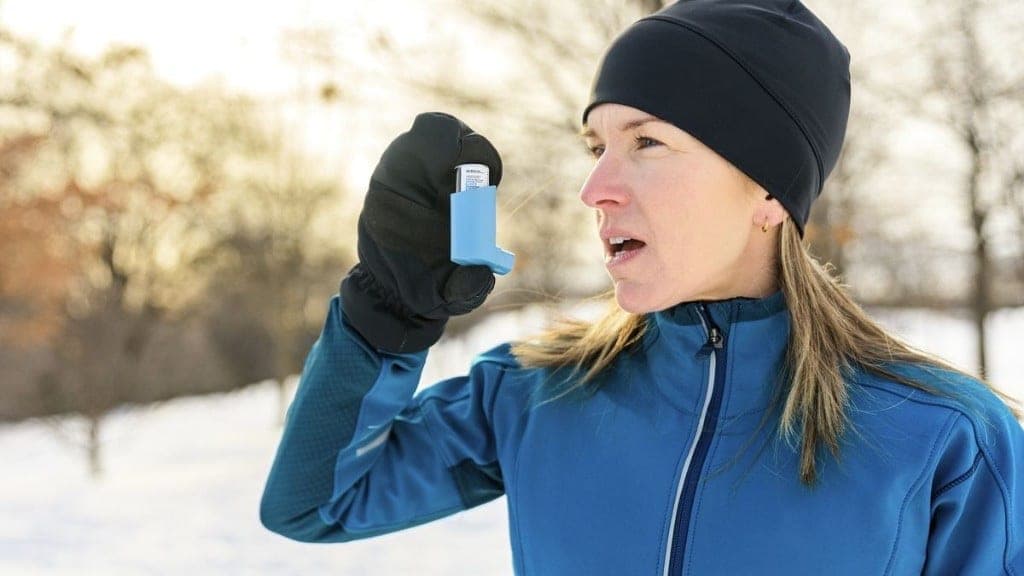
For most people with known EIB, using a short-acting bronchodilator, such as albuterol, about 15 to 20 minutes before exercise is a standard and effective prevention step. A gradual warm-up period before higher-intensity exercise has also been shown to reduce the severity of EIB, giving the airways a chance to adjust rather than being hit with sudden, heavy breathing in cold, dry conditions. Breathing through a scarf, buff, or mask during cold-weather activity helps humidify and warm the air before it reaches the lower airways, which can meaningfully reduce symptoms for many people.
A note on frequent rescue inhaler use
If you're needing your rescue inhaler before exercise on a regular basis, or symptoms are breaking through despite following standard prevention steps, that's usually a sign that your underlying asthma isn't as well controlled as it should be, not simply a normal part of winter training. In that situation, adjusting your daily controller medication, rather than relying more heavily on pre-exercise rescue inhaler use, is typically the better long-term approach.
I hear from a lot of runners, hockey players, and skiers who assume their winter breathing trouble is just something they have to push through. Often it's very manageable once we identify it correctly and put a plan in place, whether that's pre-exercise medication, a warm-up routine, or a mask for humidification. The goal is for winter training to feel the same as summer training, not something you have to grit your teeth through.
— Dr. Robert Tamayev, MD, PhD, Allergy Asthma
Which sports see this most
Athletes in cold-weather endurance sports, including hockey, cross-country skiing, and figure or speed skating, are reported to experience EIB at higher rates than athletes in warm-weather sports, likely reflecting the combination of sustained heavy breathing and cold, dry air, especially in indoor ice rinks. Exact prevalence figures vary across studies and sports, but the pattern is consistent enough that it's worth a proactive conversation with an allergist if you compete or train seriously in one of these environments.
When to book a visit
If cold-weather exercise consistently leaves you coughing, wheezing, or unable to catch your breath, even after following basic prevention steps, it's worth scheduling an evaluation to confirm the diagnosis and build a prevention plan suited to your specific sport and symptoms.
Disclaimer: This content is educational and does not substitute for medical advice. Always consult your physician for personal medical questions.