Air Quality & Asthma
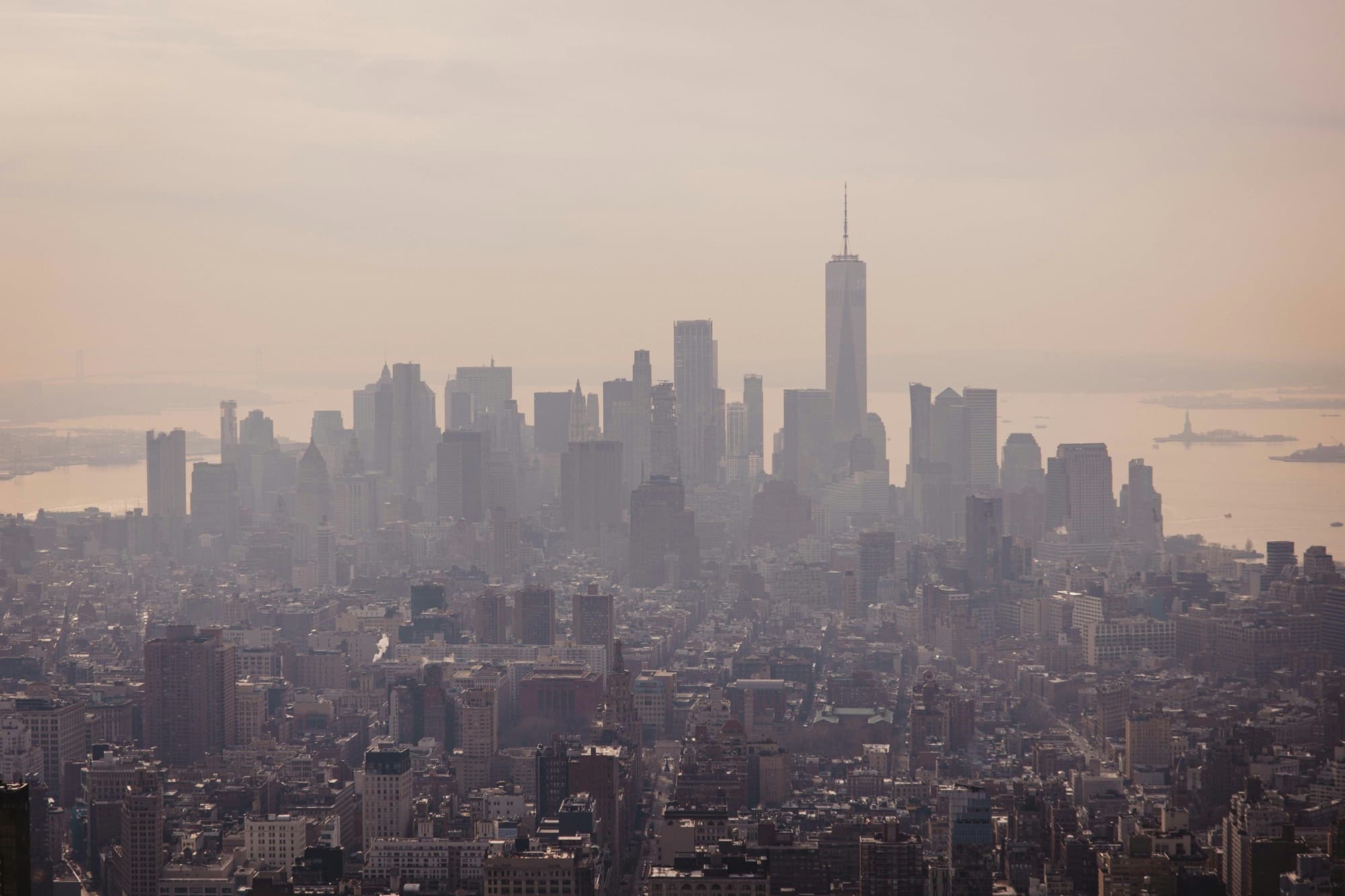
Wildfire Smoke Over NYC: What This Week's Air Quality Alert Means for Your Asthma and Allergies
The city hasn't looked like this since 2023. Here's what the smoke is doing to your lungs, who needs to be careful, and when it's worth calling us.
Published July 16, 2026 · 6 min read
Medically reviewed by Dr. Robert Tamayev, MD, PhD · Updated July 16, 2026
The short version
Smoke from the Canadian wildfires blew into New York this week and the air quality index climbed past 200, which the EPA calls "very unhealthy." We haven't seen it this bad since the summer of 2023. The problem is a pollutant called PM2.5. It's fine enough to slip deep into your lungs, and it can set off an asthma flare even if your asthma has been quiet for months. If you have asthma, COPD, heart disease, you're pregnant, or you're looking after a young child or an older relative, the advice is simple: stay inside with the windows shut, run a HEPA filter if you have one, put on a well-fitted N95 if you do go out, and keep your rescue inhaler on you. If that inhaler stops working, your lips look blue, or your chest won't loosen up, that's not a wait-and-see. Call 911.
The quick version
- The AQI went past 200 ("very unhealthy") on July 16. Over a hundred fires are still burning in Canada, and a heat wave landed at the same time. Worst smoke here since June 2023.
- The culprit is PM2.5, particles small enough to get past your nose and throat and into your bloodstream.
- Your cloth or surgical mask won't stop it. You need an N95 or KN95 that actually seals to your face.
- Asthma, COPD, heart disease, kids, older adults, pregnancy: these are the people who feel it first and worst.
- City living stacks the deck. The smoke sits on top of everyday exposures like subway platforms and traffic, so some patients are having their roughest breathing days in years.
- An inhaler that isn't helping, blue lips, or a chest that stays tight are emergencies. Get to urgent care or call 911.
What's going on out there
If your eyes have been burning all week and the sky has that dirty orange cast to it, that's not the heat. It's smoke.
The fires are up in Canada. More than a hundred of them, plenty still out of control, and the wind has been carrying all of it down into the New York area. On top of that we've had a run of hot days, so the city issued an air quality alert and the AQI pushed up into that "very unhealthy" band on the 16th. That kind of reading is rare here. The last time it got this bad was the orange-sky stretch back in June 2023, which a lot of people still remember.
For a healthy adult, this is a few miserable, scratchy-throated days and not much more. It's different if you've got asthma, allergic airway trouble, or any lasting lung or heart condition. This is the week people whose asthma has been "fine" suddenly find out it isn't, and it's why our schedule and the local urgent cares fill up fast.
Is this my allergies, or the smoke?
Fair question, because they feel almost the same from the inside. Itchy eyes, scratchy throat, a cough. But what's causing it is different, and that changes what actually helps.
POLLEN: Your immune system reacting
The body treats pollen as a threat and mounts an allergic response. Antihistamines calm that down.
WILDFIRE SMOKE: Direct irritation
PM2.5 and everything else in smoke just inflames the airway lining. An antihistamine does nothing for that.
A good tell: if it's smoke, you'll get the burning eyes and raw throat, but also a dry cough that shrugs off your usual allergy pill, a tight chest, and (if you have asthma) you'll notice yourself reaching for the rescue inhaler more than you normally would.
Why everyone keeps saying "PM2.5"
PM2.5 just means particles that are 2.5 microns across or smaller. For scale, that's roughly thirty times finer than one of your hairs. Bigger stuff like pollen gets caught in your nose and upper airway on the way in. These don't. They ride all the way down into the tiniest air sacs, and some of it crosses into your blood. That's the reason a smoke event isn't only a breathing problem. It puts a strain on your heart too.
2.5 microns: about 30× finer than a hair
Small enough to skip past your body's usual defenses and settle where the actual gas exchange happens. That's what makes it dangerous.
"I've had patients this week who've been rock-steady for a year suddenly hitting their rescue inhaler four or five times a day. That's the PM2.5. The natural instinct is to tough it out, and this is one of those weeks where toughing it out is exactly the wrong move."
— Yuliya Leviyev, NP, Allergy Asthma NY
Who should be extra careful
- Anyone with asthma or COPD, even the mild kind or the sort that only shows up when you exercise
- Kids, because they breathe faster for their size and tend to be outside more
- Older adults, and anyone with heart trouble
- People who are pregnant
- Anyone whose job keeps them outdoors
Why it hits harder if you live in the city
Two things about New York make this worse than the national headlines let on.
First, you're already breathing a fair amount of fine particulate on a normal day. Subway platforms in particular can run high, well above what you'd get on a clean street. So this week a commuter catches it twice: down on the platform, then again out in the open air.
Second, the heat isn't helping. Hot, sunny weather brews up more ground-level ozone, and heat on its own is an asthma trigger. Between the smoke and the heat advisory, your lungs are getting hit from two directions on the same day.
One more thing worth knowing: a cooling center is the right call if you don't have AC, but not all of them run HEPA filtration. If you've got asthma, it's worth a quick phone call to ask before you head over, or bring a small portable HEPA unit if you'll be there a while.
What actually helps
- Look up the AQI before you make plans. AirNow.gov or your phone's weather app both have it. Once it's over 100, anyone with asthma or allergies should cut back on outdoor time. Over 150, that goes for everybody.
- Leave the cloth mask at home. If you're going out, wear an N95 or KN95 and get it to seal snug against your face, no gaps by the cheeks or the bridge of your nose.
- Pick one room and keep it clean. Shut the windows and doors and run a portable HEPA cleaner in there, or a high-MERV filter if you've got central air. If you do one thing indoors, do this one.
- Hold off on the hard workouts. Running, cycling, anything outdoors that gets you breathing heavy, let it wait until the AQI drops back under 100.
- Keep both inhalers somewhere you can grab them fast, and if you've got an asthma action plan, now's the week to follow it.
When to call us, and when to call 911
WORTH A VISIT IF
- You're hitting the rescue inhaler more than twice a week when normally you barely touch it
- A day or two after the air clears up, the cough or the tightness is still hanging around
- This week made you realize you don't have an asthma action plan and probably should
- Your eyes or throat are still bothering you well after the smoke has moved on
⚠ URGENT CARE OR 911 IF
- The rescue inhaler isn't giving you relief
- You're badly short of breath, or can't get a full sentence out
- Your lips or fingertips are turning blue
- There's chest pain on top of the trouble breathing
We see patients for asthma and reactive-airway problems at nine offices around the city, we can usually get you in the same week, and we work in both English and Spanish. Book online or call whichever office is closest. When there's a smoke event on, we hold a few slots open for urgent breathing issues, so please don't just try to ride it out.
Questions we're getting this week
Can smoke set off my asthma even though it's usually under control?
Yes, and that catches people off guard. PM2.5 irritates the airways on its own, nothing to do with allergies, so someone who's been stable for months can still flare up. If you notice you're using the rescue inhaler more than usual, take that seriously. It's a real signal, not just an annoyance.
Do N95s actually do anything against smoke?
A real N95 or KN95 that fits well does filter PM2.5, and it's about the least you'd want outside right now. Cloth and surgical masks don't filter these particles at all. The fit is the whole game though, if there are gaps at your nose or cheeks the smoke just goes around it.
Is it OK to run the AC?
Yes, and it usually helps. Set it to recirculate instead of pulling in air from outside, and use a high-MERV filter if your unit takes one. A portable HEPA in one closed-off room is still the most effective thing you can do inside.
How do I tell smoke apart from my seasonal allergies?
Allergies are your immune system responding to pollen, and antihistamines help. Smoke is straight chemical and particle irritation that antihistamines don't fix. So if your usual allergy medicine isn't doing its job this week, the smoke is almost certainly why.
When is it an ER situation and not a wait-it-out one?
If the rescue inhaler isn't working, you can't finish a sentence, your lips or fingertips look blue, or you've got chest pain along with the breathing trouble, call 911. Don't hold out for the air to clear first.
This is general information, not a substitute for medical advice. If you think you're having an emergency, call 911.
Sources: NYC Emergency Management air-quality advisories (July 2026); New York State DEC / Governor's Office air-quality health advisories (July 2026); U.S. EPA AirNow Air Quality Index; U.S. EPA National Ambient Air Quality Standard for PM2.5.